
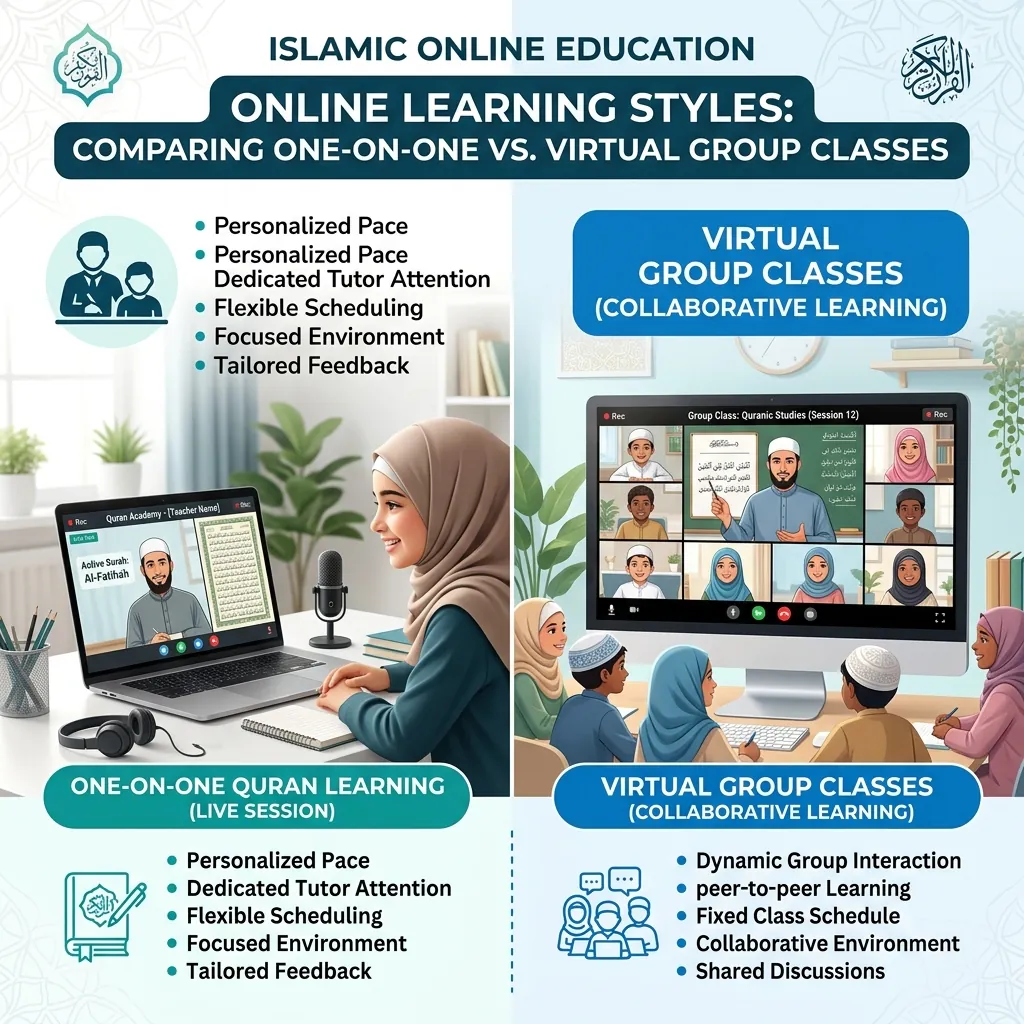
One-on-one Quran classes provide personalized instruction, immediate feedback, flexible scheduling, and lessons tailored to each student's pace. While group classes encourage interaction and may cost less, individual lessons generally help students improve their Quran recitation, Tajweed, and memorization more efficiently because every minute is focused on the learner's needs.
Table of Contents
- Understanding the Two Learning Methods
- One-on-One vs Group Quran Classes: Side-by-Side Comparison
- Benefits of One-on-One Quran Classes
- Advantages of Group Quran Classes
- Which Option Is Better for Children?
- Which Option Is Better for Adults?
- Choosing the Right Learning Style
- Frequently Asked Questions
Introduction
Choosing the right learning environment is one of the most important decisions for anyone beginning their Quran journey. Whether you're enrolling yourself or your child, you'll likely encounter two common options: one-on-one Quran classes and group Quran classes.
Both approaches have their strengths, but they serve different learning needs. Some students thrive in a classroom setting where they learn alongside others, while many benefit from the focused guidance of a dedicated teacher. The best choice depends on your goals, learning style, schedule, and level of experience.
In this guide, we'll compare both methods in detail, highlighting their advantages, limitations, and the situations where each is most effective.
Understanding the Two Learning Methods
Before comparing the two approaches, it's important to understand what each one offers.
One-on-One Quran Classes
A one-on-one Quran class involves one student learning directly with one qualified teacher. Every lesson is designed specifically for that student, allowing the teacher to adapt the pace, teaching style, and lesson plan to the learner's individual needs.
Group Quran Classes
Group Quran classes include several students learning together with one teacher. Lessons usually follow a shared curriculum, with the teacher dividing attention among the entire class.
One-on-One vs Group Quran Classes: A Quick Comparison
| Feature | One-on-One Classes | Group Classes |
|---|---|---|
| Teacher's attention | Fully focused on one student | Shared among several students |
| Learning pace | Personalized | Based on the group |
| Immediate correction | Yes | Limited by class size |
| Class participation | Continuous | Shared with classmates |
| Schedule flexibility | High | Usually fixed |
| Suitable for beginners | Excellent | Good, depending on class size |
| Tajweed improvement | Faster due to constant feedback | Slower if individual corrections are limited |
Benefits of One-on-One Quran Classes
Benefit #1: Personalized Learning
Every student learns differently. Some children memorize quickly but struggle with pronunciation. Others have excellent Tajweed but require additional revision. In a one-on-one class, the teacher can tailor lessons to the student's specific needs.
Benefit #2: Faster Correction of Mistakes
Correct pronunciation is essential when reciting the Quran. During an individual lesson, the teacher can correct each letter as soon as it is pronounced incorrectly, demonstrate the correct articulation point (Makhraj), and provide instant feedback.
Benefit #3: Learn at Your Own Pace
In group classes, the teacher usually follows a schedule designed for the majority of students. One-on-one learning removes this challenge, allowing students to spend extra time on difficult lessons or progress more quickly when they master a concept.
Benefit #4: Better Focus During Lessons
Because there are no classmates competing for the teacher's attention, students are more likely to stay engaged throughout the lesson. This individualized interaction often leads to improved concentration and greater participation.
Benefit #5: Greater Flexibility for Busy Families
One-on-one Quran classes offer greater flexibility because lessons can often be arranged around the student's availability, which is especially beneficial for working parents or students with changing schedules.
Benefit #6: Customized Learning Goals
Every student's Quran journey is different. In a one-on-one setting, the teacher can design lessons around specific goals like learning Noorani Qaida, improving Tajweed, or memorizing the Quran (Hifz).
Advantages & Challenges of Group Quran Classes
Advantages
- Collaborative Learning: Students can learn alongside classmates and ask questions.
- Social Interaction: Children often enjoy learning with friends.
- Shared Motivation: Watching classmates make progress can encourage students.
- Lower Cost: Group classes are often more affordable than private lessons.
Challenges
- Limited Individual Attention: The teacher must divide time among all students.
- Different Learning Speeds: Some may struggle to keep up, while others feel held back.
- Fewer Individual Corrections: Pronunciation mistakes may not receive immediate attention.
- Less Flexible Scheduling: Fixed schedules may not suit every family's routine.
Which Option Is Better for Children?
For younger learners, especially beginners, one-on-one classes often provide the strongest foundation. Children benefit from constant encouragement, immediate correction of mistakes, and a pace that matches their individual ability.
However, some older children enjoy the social aspect of group learning and may thrive in a well-managed classroom environment.
Which Option Is Better for Adults?
Adult learners often have unique goals and busy schedules. Many adults prefer one-on-one lessons because they can ask questions freely, focus on specific areas of improvement, learn at a comfortable pace, and schedule classes around work commitments.
How to Choose the Right Option
Before selecting a class format, consider your learning goals (e.g., reading fluently, improving Tajweed, or memorizing), how much individual guidance you need, your schedule flexibility, and what motivates you or your child.
Frequently Asked Questions
Are one-on-one Quran classes better than group classes?
Both have advantages, but one-on-one classes are generally better for students who need personalized guidance, faster progress, and immediate correction.
Which class format is best for beginners?
Beginners often benefit most from one-on-one lessons because they receive continuous support while learning pronunciation, Tajweed, and the basics.
Do private Quran classes improve Tajweed faster?
In many cases, yes. Because the teacher listens to every recitation and provides immediate corrections, students often improve their pronunciation more quickly.
Final Thoughts
Both one-on-one and group Quran classes can help students build a strong relationship with the Quran. The right choice depends on the learner's goals, personality, and preferred learning style.
For students who value individualized attention, flexible scheduling, personalized lesson plans, and continuous feedback, one-on-one classes provide an environment where they can develop confidence and make steady progress.
Experience Personalized Learning
At Quranic Seekers Academy, we offer tailored one-on-one online Quran classes for children and adults, designed to help you achieve your learning goals at your own pace.
Book Your Free Trial Today